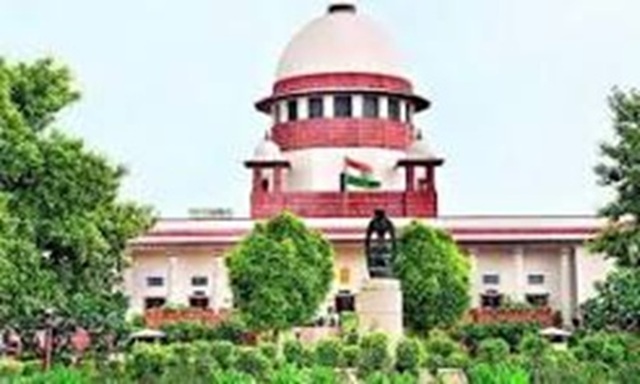
New Delhi, Oct 21: The Supreme Court has held that a Judicial Officer who was wrongfully discharged from service cannot be denied career progression, including Selection Scale and Super Time Scale, merely because the requisite Annual Confidential Reports were unavailable for the period he was unlawfully kept out of service.
A Bench of Justices J B Pardiwala and Manoj Misra said an employer cannot rely on its own wrongful act, specifically a wrongful discharge or dismissal, to deny an employee the consequential service benefits, including selection scales or promotions, that the employee would have earned had he remained in service.
The Supreme Court said where the requisite number of ACRs are unavailable because the employer itself wrongfully kept the employee out of service, the employee's eligibility for promotion or higher pay scales must be assessed on the basis of the remaining valid ACRs available on record.
The Bench also emphasized that a public servant cannot be prejudiced by the non-communication of ACRs. Uncommunicated ACR entries cannot be used to the detriment of an employee while determining his career advancement or entitlement to higher pay scales.
The matter concerned Abhay Jain, who was appointed as a Judicial Officer in the District Judge Cadre of the Rajasthan Judicial Service in 2013. He was discharged from service in 2016, following which he approached the Rajasthan High Court. His writ petition was dismissed.
Jain then approached the Supreme Court, which in 2022 allowed his appeal, quashed the discharge order and directed his reinstatement with continuity of service, seniority and all consequential benefits, along with 50% back wages.
Following his reinstatement, the issue of his Selection Scale and Super Time Scale came up for consideration.
The Full Court of the Rajasthan High Court, in 2024, found Jain not suitable for grant of Selection Scale or Super Time Scale. However, the decision did not state reasons for reaching that conclusion.
The Rajasthan High Court subsequently approached the Supreme Court seeking clarification on whether the consequential benefits granted by the 2022 judgment would include Selection Scale and Super Time Scale despite the absence of the requisite ACRs.
Considering the matter, the Bench noted that the Supreme Court had already held in the present case that Jain was wrongfully discharged from service.
Court said it was therefore a "natural and inevitable corollary" that Jain could not have earned the requisite number of ACRs for the period during which he was kept out of service.
"The absence of the requisite ACRs, therefore, is not attributable to any omission, default or deficiency on the part of the opponent, but is solely the direct consequence of the applicant's wrongful action," the Bench said.
Court held that it would be manifestly unjust to allow the employer to rely on a shortcoming that it had itself created to deny the employee consequential service benefits.
The Bench further emphasized that the law does not permit a party to derive an advantage from its own wrongful act. Consequently, the opponent cannot be made to bear the adverse consequences of the wrongful discharge, by being denied consideration for the grant of the Selection Scale or the Super Time Scale on the ground of non-availability of the requisite number of ACRs," it said.
It held that Jain's entitlement had to be assessed on the basis of his remaining valid ACRs for 2013 and 2014, which contained "Very Good" and "Good" entries. The ACR for 2015, which had not been communicated, could not be relied upon against him.
The Supreme Court held that giving full effect to its earlier order of reinstatement meant that Jain should receive the benefits from the dates on which he would have become eligible in the normal course of service.
Since Jain was appointed as an Additional District Judge on July 15, 2013, he completed five years of service in July 2018 and became eligible for consideration for Selection Scale from July 16, 2018.
Supreme Court accordingly held that Jain was entitled to Selection Scale with effect from July 16, 2018. Since three years in Selection Scale were required for eligibility for Super Time Scale, Court held that he was entitled to Super Time Scale with effect from July 16, 2021.
The Bench further directed that the arrears arising from the grant of the two scales would be calculated in accordance with the Supreme Court's March 15, 2022 Judgment, including its direction regarding payment of 50% back wages.
It directed the Rajasthan High Court to re-fix Jain's pay, revise all consequential benefits and disburse the arrears payable to him within three months.
|