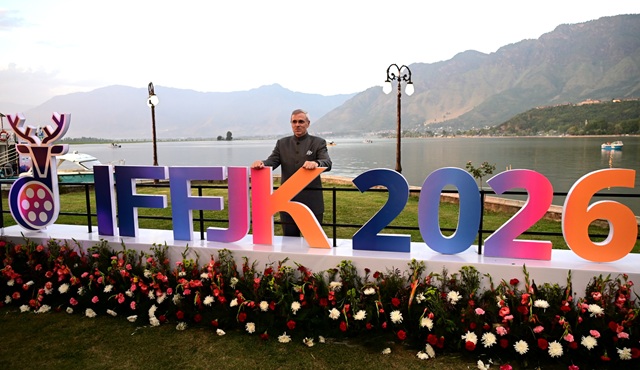
SRINAGAR, SEPTEMBER 07: Chief Minister Omar Abdullah today inaugurated the first International Film Festival of Jammu & Kashmir (IFFJK) at the Sher-i-Kashmir International Convention Centre (SKICC), marking a new chapter in Jammu & Kashmir’s long and enduring relationship with cinema.
The four-day festival brings together filmmakers, artists, delegates and cinema enthusiasts from across the world, with participation from over 30 countries and more than 130 films being showcased during the festival.
Describing the inaugural edition of IFFJK as more than a celebration of cinema, the Chief Minister said the festival shall portray Jammu & Kashmir’s as a vibrant and alluring destination for filmmakers, storytellers and creative talent from across India and the world.
“Today, as we launch this festival, bringing together filmmakers from over 30 countries and showcasing over 130 extraordinary films, we are not just opening a cinema event.
We are opening a new chapter in the longstanding romance between Jammu & Kashmir and the silver screen,” the Chief Minister said.
Welcoming the distinguished guests, filmmakers and delegates, Omar Abdullah said Kashmir was a place where stories were not merely hosted but born. “To stand here today, under the majestic shade of the Chinar trees, surrounded by the sentinel peaks of the Himalayas, is to be reminded that some places on earth do not merely host stories—they are born of them,” he said.
Referring to Kashmir’s enduring appeal to filmmakers, the Chief Minister described the region as “the world’s most breathtaking natural canvas” and said the launch of the festival was an assertion that Jammu & Kashmir was ready to welcome the global creative community.
“We are declaring to the world that Kashmir is not just a location on a call sheet; it is a creative sanctuary, a home for global storytellers, and a voice that is ready to speak to the world,” he said.
Recalling the deep imprint of Jammu & Kashmir on Indian cinema, the Chief Minister said the region had provided the backdrop for some of the most memorable moments in the history of the silver screen.
He recalled the iconic portrayal of Kashmir in films such as Junglee, Kashmir Ki Kali, Aradhana and Bobby, noting how the landscapes of Gulmarg and Dal Lake became part of the visual imagination of generations of Indians.
Referring to Shammi Kapoor’s iconic sequence in Junglee, Omar Abdullah said the famous “Yahoo!” moment on the snow-covered slopes of Gulmarg had come to symbolise an entire generation’s idea of joy and freedom.
He also recalled the imagery of Sharmila Tagore against the waters of Dal Lake in Kashmir Ki Kali and the youthful romance of Rishi Kapoor and Dimple Kapadia in Bobby, including the iconic Bobby Hut in Gulmarg.
The Chief Minister particularly acknowledged the contribution of legendary filmmaker Yash Chopra in creating a distinct cinematic language around Kashmir.
“Directors like Yash Chopra did not just film here—they built a visual language around this land,” he said, referring to films including Silsila, Kabhi Kabhie and Jab Tak Hai Jaan.
He said the changing seasons of Kashmir—from the vivid greens of spring and golden hues of autumn to the quiet white of winter—had enabled filmmakers to mirror the entire spectrum of human emotions.
Omar Abdullah also referred to the evolution of cinema in Kashmir in more recent decades, citing films such as Mission Kashmir, Haider, Rockstar, Highway and Bajrangi Bhaijaan.
He praised filmmakers Vidhu Vinod Chopra, Vishal Bhardwaj, Imtiaz Ali and Kabir Khan for bringing different dimensions of Kashmir to the screen, while observing that cinema in the region had increasingly moved beyond conventional representations to explore deeper and more nuanced human narratives.
Recalling some of his favourite Hindi film songs shot in Jammu & Kashmir, the Chief Minister spoke fondly of Kabhi Kabhie Mere Dil Mein, picturised on Amitabh Bachchan and Rakhee; Tere Bina Zindagi Se from Aandhi, featuring Sanjeev Kumar and Suchitra Sen against the backdrop of Martand Temple; and Yeh Vaada Raha, filmed at the Shiv Temple in Gulmarg.
“Do not just film our mountains; seek out our stories” The Chief Minister emphasised that Jammu & Kashmir’s appeal to cinema extended far beyond its landscapes.
“Cinema is more than landscapes; cinema is culture. And the true beauty of Jammu and Kashmir lies in its soul—its cultural ethos, built on Kashmiriyat, warmth, hospitality, and a rich artistic tradition,” he said.
Describing Jammu & Kashmir as a land of storytellers, Omar Abdullah highlighted its rich traditions of music, crafts and oral storytelling, including the Santoor and Rabab, Sufiyana Kalam and Rouff.
He also drew attention to the region’s renowned craftsmanship, including walnut wood carving and the intricate art of carpet weaving, as well as its distinctive culinary and cultural traditions represented by Kahwa and the saffron fields of Pampore.
Addressing filmmakers participating in the festival, he urged them to explore the region’s living culture and people rather than restricting their lens to its mountains and scenic beauty. “When you bring your cameras to Jammu and Kashmir, do not just film our mountains. Seek out our stories. Talk to our artisans, listen to our musicians, walk through our old city lanes, and let the living, breathing culture of this land infuse your narratives,” he said.
The Chief Minister said nostalgia alone could not build a sustainable film industry and stressed the need for a modern ecosystem capable of supporting filmmakers through the entire production process. “Under our comprehensive Jammu & Kashmir Film Policy, we have transformed J&K from a beautiful location into one of the most filmmaker-friendly destinations in the world,” he said.
Highlighting the key provisions of the policy, Omar Abdullah said Jammu & Kashmir has introduced a single-window clearance system to simplify the process of obtaining permissions for film shooting.
Through a dedicated online portal, filmmakers can seek necessary permissions, including location approvals and security coordination, through a streamlined mechanism involving designated nodal officers.
He said the policy also provides financial incentives and production subsidies for filmmakers shooting in J&K, with support linked to shooting days and local expenditure, covering independent filmmakers as well as larger productions.
The policy, he added, also seeks to strengthen local participation in the film industry by incentivising productions that employ local artists, technicians and crew members and promote the cultural heritage of Jammu & Kashmir.
“We are building a robust local workforce of cinematographers, line producers, sound engineers, and actors so that you can arrive with a script and find everything else right here,” the Chief Minister said.
He further announced the government’s intent to invest in modern post-production facilities, equipment banks, film studios and film education institutions across Jammu & Kashmir, with the objective of creating a complete, end-to-end production ecosystem.
The Chief Minister said the government was treating cinema not merely as entertainment but as an industry capable of generating employment, nurturing young talent and building bridges between cultures.
“This festival belongs to our young people” Calling the first edition of IFFJK a “declaration of intent”, Omar Abdullah said the festival would provide an important platform for young people of Jammu & Kashmir to engage with filmmakers and creative professionals from across the world. “Over the next four days, as you watch films from every corner of the world, engage in master-classes, panel discussions, and casual conversations over tea,
I urge you to look beyond the screen,” he said. Pointing towards the young people attending the festival, he said Jammu & Kashmir’s youth were passionate, creative and digitally connected, with aspirations to become writers, directors, actors and other professionals in the creative industries.
“This festival belongs to them as much as it belongs to our distinguished international guests,” he said. The Chief Minister urged international and national delegates to take the experience of Jammu & Kashmir back with them and share the message that the region was ready to welcome filmmakers and production crews. “Carry a piece of J&K back in your hearts. Tell your fellow filmmakers that Kashmir is open, safe, vibrant, and eager to welcome your crews,” he said.
He also encouraged local youth to use the festival as an opportunity to discover new possibilities and tell their own stories. “Your stories matter. Your voices matter. The world is listening, and now, the world’s screen is right here in your home,” Omar Abdullah said.
Concluding his address, the Chief Minister described cinema as a universal language that transcends borders and connects people through shared human experiences.
“Let us celebrate the magic of cinema—the universal language that knows no borders, requires no translation of the heart, and reminds us of our shared humanity,” he said.
He then formally declared the 1st International Film Festival of Jammu and Kashmir open. Union Minister of State in the Prime Minister’s Office, Dr Jitendra Singh; several Governors and Lieutenant Governors; Council of Ministers; former J&K Chief Minister Dr Farooq Abdullah, Members of J&K Legislative Assembly; filmmakers, eminent artists, members of the jury and other distinguished guests attended the inaugural ceremony.
|