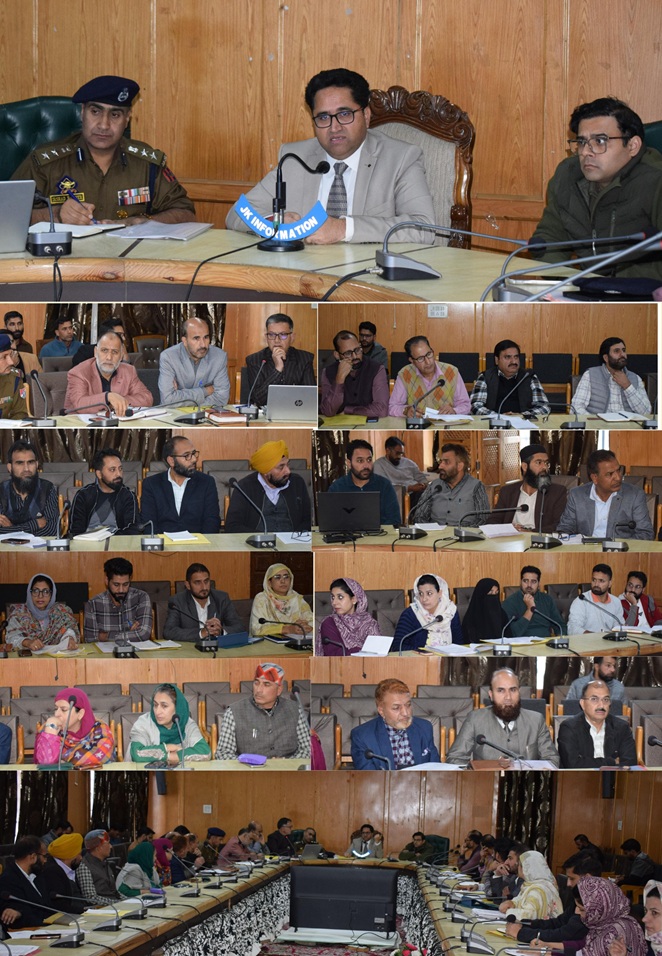
PULWAMA, OCTOBER 15: A meeting of the District-Level Narco Coordination Centre (NCORD) was held today at Circuit House Pulwama under the chairmanship of Deputy Commissioner (DC) Pulwama, Kuldeep Krishan Sidha, to review the overall drug situation in the district and assess the progress of enforcement, prevention, rehabilitation and awareness measures under the Nasha Mukt Bharat Abhiyaan (NMBA).
At the outset, a detailed presentation was made before the Chair covering the status of mass and IEC campaigns under NMBA, rehabilitation and counselling services, functioning of the Addiction Treatment Facility (ATF) and Drug De-Addiction Centre (DDAC) Tral, training of departmental functionaries, action against illicit cultivation, vehicles seized in NDPS cases, action taken against driving licences involved in drug-related activities and the status of cases pending before the NDPS Court.
The presentation also highlighted the extensive awareness and outreach activities conducted across Panchayats, Urban Local Bodies and educational institutions, besides the progress achieved in counselling, rehabilitation, follow-up and community participation.
During the meeting, the Deputy Commissioner called for comprehensive hotspot mapping of areas vulnerable to drug availability, supply and consumption, with the Police Department and concerned agencies tasked to identify the complete chain through which drugs enter, move and reach consumers.
He stressed the need to break the entire drug ecosystem and called for close coordination among departments to identify the source, movement and distribution network and take effective action against it.
The DC stressed the need for identification, naming and shaming of persons involved in the drug trade, strictly as per law and due legal procedure, while directing the Police and concerned agencies to intensify efforts to track the backward linkages and supply networks behind drug-related cases.
He called for intelligence-based investigation to identify those financing, supplying and facilitating the drug trade rather than limiting action to the end users.
The DC emphasized that the fight against drug abuse requires a balanced approach combining enforcement with compassion, counselling, rehabilitation and social reintegration. He stressed the need for proper tracking and follow-up of persons affected by substance abuse and those who have undergone rehabilitation to prevent relapse.
He further called for mapping trained counsellors and sharing their details with the Police and other concerned agencies, wherever required, for coordinated counselling, follow-up and intervention. He also stressed that all telephonic counselling sessions should be properly registered along with relevant patient identification details to ensure continuity of treatment and follow-up.
The Deputy Commissioner underscored that rehabilitation must translate into sustainable reintegration and observed that livelihood is one of the most effective tools for keeping rehabilitated persons away from drugs. He called for skill mapping through appropriate IT-enabled mechanisms so that the capabilities and interests of such persons can be matched with suitable skill development, self-employment and livelihood opportunities.
He also suggested a coordinated programme called Triple ‘S’, comprising Skill Development, Self-Employment and Sports, to engage youth and rehabilitated persons in constructive activities.
The DC asked ACD Pulwama to explore the potential of Self Help Groups (SHGs) as an important tool for convergence, livelihood generation and social reintegration.
He stressed that departments must work together to create meaningful opportunities for persons coming out of addiction and ensure that they are not pushed back into the same environment.
Reviewing the progress under NMBA, the DC stressed that the campaign should demonstrate visible and measurable results on the ground rather than remain confined to activities and statistics. He called for saturation of awareness and prevention efforts up to every household and the last ward, with special focus on vulnerable locations and identified hotspots.
He also emphasized greater involvement of public representatives, religious organisations, Friday sermons and other community institutions in creating sustained awareness against drug abuse.
The DC further called for greater involvement of Youth Clubs in prevention, awareness, sports and community outreach activities, observing that organized engagement of youth can play an important role in keeping young people away from substance abuse.
The Deputy Commissioner called for documenting and highlighting success stories of rehabilitated persons to inspire other affected persons and their families and help reduce the stigma associated with seeking treatment and rehabilitation. He also directed the concerned authorities to operationalize a dedicated toll-free helpline named “KAS VANAV” for reporting drug abuse, social abuse and related concerns.
He envisaged an IVR-based mechanism through which information could be recorded, tickets generated and cases immediately routed to the concerned agencies for necessary action and follow-up.
On illicit cultivation, the DC called upon Jal Shakti, Rural Development, R&B, Revenue and other concerned departments to intensify coordinated identification and destruction of cannabis and other illicit crops, particularly along rivers, roadsides, government land and other vulnerable areas.
He called for active engagement of Tehsildars, Patwaris, Chowkidars and other field-level functionaries for timely reporting and effective monitoring, with accountability fixed wherever required.
The DC also called for intensified action, in coordination with local Police and Revenue authorities, against the sale of tobacco and other addictive substances in and around educational institutions.
He stressed the need for sustained enforcement and awareness campaigns in such areas to safeguard students from exposure to addictive substances.
Calling for stronger institutional coordination, the DC urged all line departments to work through a convergent and coordinated mechanism to address the multi-dimensional challenges associated with drug abuse.
He called upon college principals and heads of educational institutions to maintain heightened vigilance regarding substance abuse among students and strengthen preventive and awareness measures on campuses. He also stressed coordinated engagement of financial institutions and other stakeholders to facilitate rehabilitation, livelihood and self-employment opportunities.
The DC also called for regular capacity-building and specialized training of Police personnel to strengthen their ability to identify drug networks, investigate NDPS cases, trace supply chains and track backward linkages.
He further suggested that officials demonstrating exemplary performance in the fight against drug abuse should be appropriately recognized and incentivized to encourage sustained and result-oriented efforts.
Speaking on the occasion, SSP Pulwama, Sahil Sarangal, apprised the Chair of the enforcement measures being undertaken by the Police Department against the drug trade and NDPS-related activities.
He stressed the importance of hotspot identification, intelligence-based operations, tracing of supply networks and coordinated action with Revenue, Health, Social Welfare and other concerned departments.
The Deputy Commissioner reiterated that the objective must be to break the drug ecosystem from both ends, by preventing access to drugs and by supporting affected persons to return to a productive and dignified life.
He emphasized that sustained inter-departmental coordination, community participation, rehabilitation, youth engagement and strict enforcement against those involved in the drug trade are essential to achieving a drug-free district.
The meeting was attended by SSP Awantipora Irshad Hussain Rather, ADC Pulwama, ADC Awantipora, ADC Tral, ACR, CMO, ACD and other senior officers, besides representatives of Health, Social Welfare, Agriculture, Horticulture, Jal Shakti, R&B, Revenue, Education, Excise & Taxation, Police, NIC, RPF, NCB and other concerned departments and stakeholders.
|