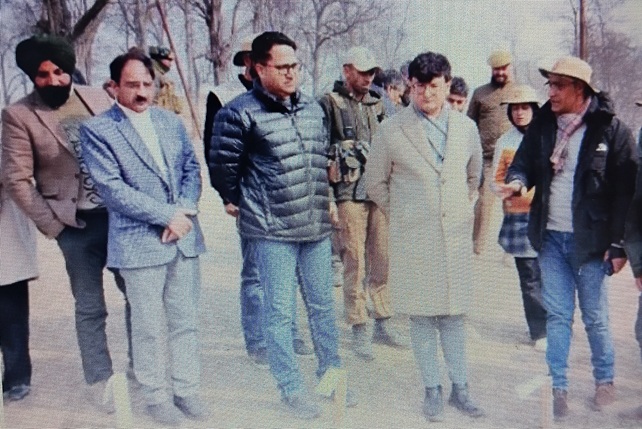
Baramulla, Nov 30: Archaeologists have unearthed extensive architectural remains of a major Buddhist complex at Zehanpora in Baramulla district & has added that it could become one of the most significant early-historic Buddhist sites in the Himalayan region.
The ongoing excavation jointly undertaken by the Centre of Central Asian Studies, University of Kashmir, and the J&K Department of Archives, Archaeology & Museums is expected to redefine the understanding of ancient Kashmir’s cultural and religious landscape.
Project Director Dr Mohammad Ajmal Shah, who heads the CCAS team, said the findings will contribute significantly to the archaeological map of the region. The excavation marks the first major collaborative archaeological mission in Jammu & Kashmir undertaken with formal permission under Archaeological Survey of India regulations.
The project was launched following extensive preliminary surveys that included drone imagery, mapping, and ground verification, which identified several large mounds near Zehanpora long believed to be remnants of ancient stupas.
A key breakthrough came in 2023 when Dr Shah traced an old photograph in a French museum archive showing three stupas in Baramulla, helping establish a historical link between the site and Kashmir’s Buddhist heritage. Subsequent fieldwork confirmed that the mounds correspond to substantial remains of a stupa complex and associated architecture, pointing to what researchers describe as a thriving early-historic, Kushan-period Buddhist settlement.
The project follows a landmark Memorandum of Understanding signed on October 31 between DAAM and CCAS to strengthen archaeological research, documentation, and heritage management in Jammu & Kashmir.
The MoU provides for joint excavations, preservation of artefacts, 3D documentation, and heritage-tourism promotion. This joint excavation marks a landmark initiative in archaeological research in Jammu & Kashmir,” said K.K. Sidha, Director of DAAM.
The discoveries at Zehanpora will enrich local as well as wider understanding of our cultural heritage. Formal excavation began in early November, making it the first large-scale dig undertaken under the new partnership.
In the coming weeks, researchers will focus on deeper excavation, scientific analysis, and developing a conservation plan that may support museum displays, academic studies, and heritage-tourism initiatives. Officials also intend to engage local communities through outreach and awareness programmes to promote protection of archaeological sites.
|