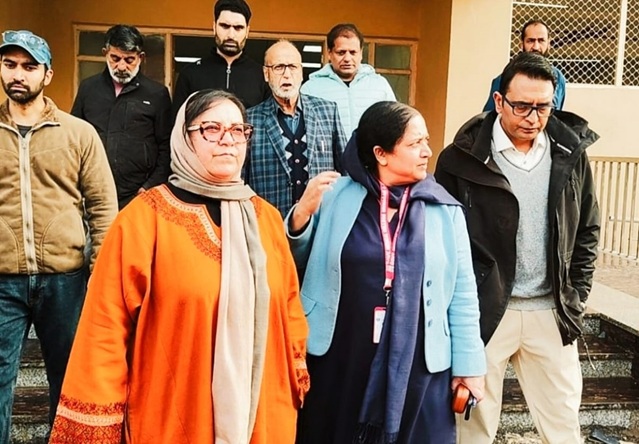
SRINAGAR, NOVEMBER 23: Minister for Health & Medical Education and Social Welfare, Sakeena Itoo today reviewed the winter preparedness of Government Medical Colleges (GMCs) of Kashmir Division, taking stock of healthcare arrangements, emergency response mechanisms, availability of essential medicines, medical equipment, manpower and patient-care facilities to ensure uninterrupted healthcare delivery during the harsh winter months.
The meeting was attended by Commissioner Secretary Health and Medical Education, Saugat Biswas; Director Finance Health and Medical Education department, Administrator GMC Srinagar, Principals of GMCs of Srinagar, Anantnag, Baramulla and Handwara, Principal Dental College Srinagar, Director Health Services Kashmir, Medical Superintendents of all District and Sub-district hospitals of Kashmir division, representatives of JKMSCL, State Health Agency and other concerned officers .
During the review meeting, the Minister stressed on the need for comprehensive advance planning, particularly for people residing in far-flung, remote and snowbound areas, where severe weather conditions and road closures often pose challenges in accessing timely medical attention.
Giving special emphasis to maternal healthcare, Sakeena Itoo directed the concerned authorities to conduct a comprehensive advance survey of expecting women residing in snowbound and inaccessible areas and maintain an updated, district-wise database of such cases.
She called for identifying expectant mothers, particularly those nearing their delivery dates or requiring specialised medical attention, well before the onset of severe weather conditions.
The Minister directed the health authorities to ensure that vulnerable pregnant women are appropriately assessed and wherever medically required, shifted in advance to safer locations closer to healthcare institutions having adequate maternity and emergency facilities. “No pregnant woman from a snowbound or remote area should be left without timely medical assistance because of weather-related disruptions.
We must identify such cases beforehand, assess their requirements and put necessary arrangements in place so that no emergency is allowed to turn into a crisis due to lack of preparedness”, the Minister emphasised.
She further directed the concerned GMC administrations and health authorities to establish effective coordination with district administrations, Chief Medical Officers, field-level health institutions, SDRF, Traffic authorities and other concerned to facilitate timely transportation, referral and admission of patients during weather exigencies.
She also asked them to establish a team of officials for monitoring weather advisories so that timely action can initiated in case of any exigency. Highlighting the importance of a well-defined referral mechanism, Sakeena Itoo stressed that patients referred from Sub-District Hospitals (SDHs) and District Hospitals (DHs) to tertiary care institutions must be managed through a proper, systematic and well-coordinated referral protocol.
She called for ensuring that patients requiring specialised treatment are referred to the appropriate higher healthcare institutions without unnecessary delays, with proper clinical assessment, documentation, stabilisation and prior communication with the receiving hospital.
The Minister also directed the officers to ensure close coordination between the referring and receiving hospitals in advance of transferring any critically ill patient.
She further instructed that an experienced medical professional should accompany every critical patient being referred to tertiary care hospitals to ensure proper medical supervision and continuity of care during transit.
The Minister observed that an effective referral system would not only reduce avoidable delays but also ensure optimum utilisation of available healthcare infrastructure at different levels. “District and Sub-District Hospitals are the first critical points of healthcare delivery. Their role in assessing, stabilising and appropriately referring patients is extremely important.
Every referral must follow a proper protocol, ensuring that patients receive the required treatment at the right institution without unnecessary movement or delay”, she said.
The Minister also reviewed the availability of essential medicines, emergency drugs, oxygen supplies, blood components, heating arrangements, backup power supply, ambulances and other critical medical facilities at GMCs and their associated hospitals. She directed the administrations to undertake a thorough assessment of infrastructure and equipment requirements and ensure that all essential facilities remain functional throughout the winter season.
“Special attention must be given to emergency departments, maternity and neonatal care units, intensive care facilities, operation theatres and other critical patient-care services”, she said.
Sakeena Itoo also stressed the need for adequate deployment of doctors, nursing staff, paramedics and other supporting personnel, particularly in emergency and critical-care departments, so that healthcare services are not affected by heavy snowfall, road blockades or other weather-related challenges.
She called for strengthening inter-institutional coordination and ensuring that all GMCs maintain effective communication channels with associated hospitals and peripheral health institutions for prompt response to medical emergencies.
The Minister directed the concerned officers to identify potential bottlenecks in advance and take corrective measures rather than waiting for situations to arise during extreme weather conditions.
Emphasising that winter preparedness must translate into tangible improvements in patient care, the Minister called upon all heads of institutions to adopt a proactive, coordinated and patient-centric approach.
“Preparedness is not merely about stocking medicines or making infrastructure arrangements; it is about ensuring that every patient, irrespective of where they live, gets timely and quality healthcare even under the most challenging weather conditions,” she added.
Taking stock of other issues, the Minister directed the hospital authorities to display rates of testing facilities available in health institutions. She also asked them to display rates of tests requiring payments in the hospital as well as those available for free for the facilitation of general public.
The Minister also directed the Medical Superintendents of district hospitals to display OPD schedule and names of consultants and doctors available during the day and night shifts alongwith contact numbers so that the people are facilitated effectively while coming for medical reasons.
She also asked the Hospital administrators to strengthen complaint redressal mechanism and maintain complaint register in each of their hospitals so that public can register their grievances on spot.
The Minister reiterated the Government’s commitment towards strengthening the healthcare delivery system across Jammu and Kashmir, with particular focus on vulnerable populations and residents of remote and snowbound areas, ensuring that geographical isolation and adverse weather do not become barriers to access to essential medical services.
|