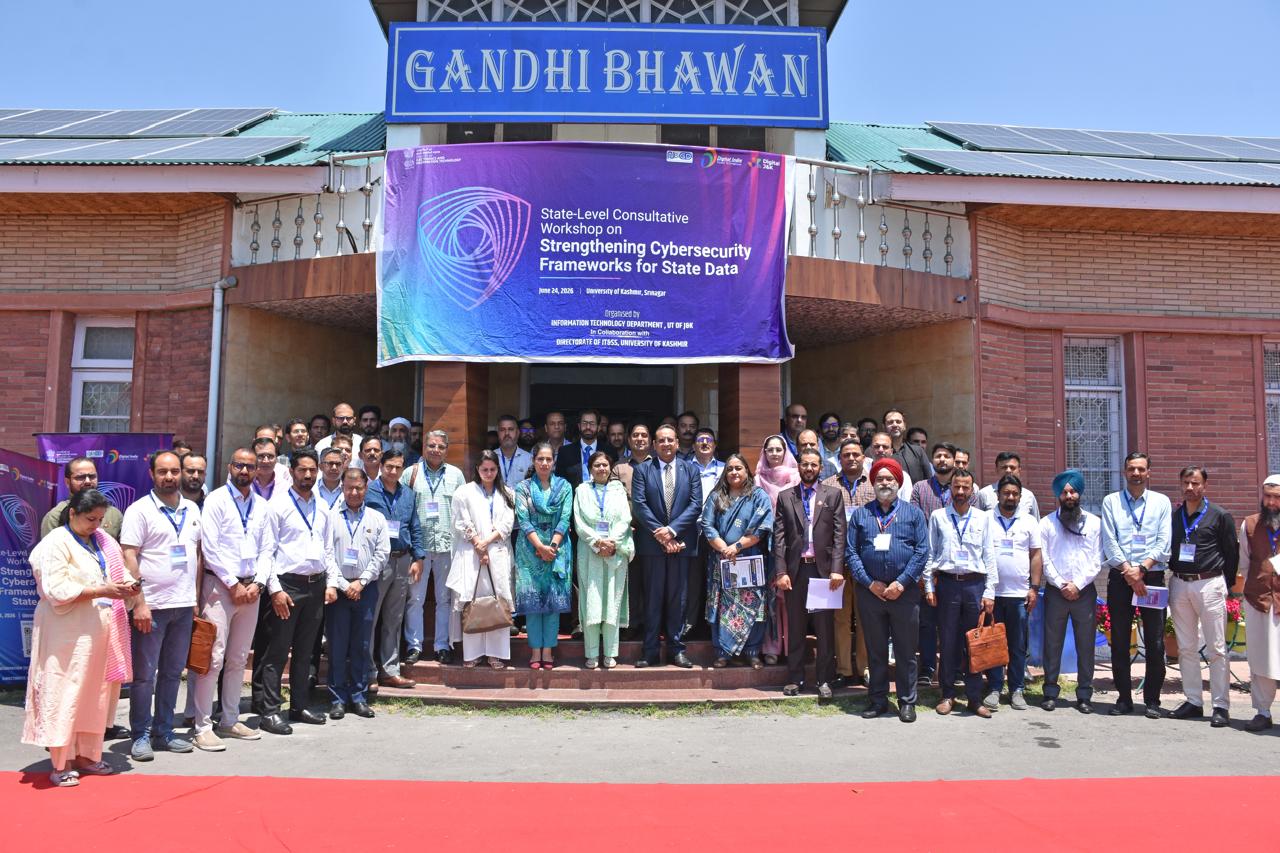
Srinagar, June 24, 2026: The Information Technology Department, Government of Jammu & Kashmir, in collaboration with the University of Kashmir and with support from the National e-Governance Division (NeGD), Ministry of Electronics and Information Technology (MeitY), Government of India, today organized a State-Level Consultative Workshop on “Strengthening Cyber Security Frameworks for State Data” at the University of Kashmir, Srinagar.
The workshop was organized as part of the national consultative process being undertaken by NeGD, MeitY, to facilitate stakeholder consultations and develop a comprehensive framework for strengthening cybersecurity, data protection, and digital resilience across States and Union Territories.
The inaugural session was attended by Prof. Nilofer Khan, Hon’ble Vice Chancellor, University of Kashmir; Sh. Saurabh Bhagat, IAS, Commissioner / Secretary to the Government, Information Technology Department; Smt. Asha Choudhary Malhotra, IAS, Chief Executive Officer, JaKeGA; Prof. Naseer Iqbal, Registrar, University of Kashmir; Sh. Abdul Hafiz Shah, JKAS, Special Secretary to Government, Information Technology Department; Sh. Shokat Mehmood, JKAS, Special Secretary to Government; Shri Jaskaran Singh Modi, State Informatics Officer, NIC J&K; Dr. Maroof Naieem Qadri, Director IT, University of Kashmir; Mr. Ashaq Hussain Dar, Director, NIELIT, besides representatives from NeGD, CERT-In (through VC), NIC, J&K Bank, SeMT, JaKeGA, Academia, and Senior Officers of various Government Departments who are also nominated as CISOs / ISOs / Technical Experts.
Addressing the participants, Saurabh Bhagat, IAS emphasized that cybersecurity has emerged as a critical pillar of digital governance and citizen trust. They highlighted the growing dependence of government institutions on digital platforms for delivery of public services and underscored the need for robust cybersecurity mechanisms, proactive threat management, and resilient digital infrastructure to safeguard critical government systems and citizen data.
The workshop brought together policymakers, cybersecurity experts, government officials, academia, and industry stakeholders to deliberate on emerging cyber threats, cybersecurity best practices, incident response mechanisms, data protection frameworks, and institutional measures required to strengthen cyber resilience across the Union Territory.
A major highlight of the workshop was the breakout group discussions, where participants deliberated on six key thematic areas, including risk-based security assessments, securing State Data Centres and State Wide Area Networks, strengthening Security Operations Centres (SOCs) and Computer Security Incident Response Teams (CSIRTs), modernizing legacy systems, implementing data protection and privacy frameworks, and enhancing cybersecurity capacity-building initiatives.
The discussions focused on strengthening cybersecurity governance, enhancing monitoring and incident response capabilities, securing critical digital infrastructure, promoting secure-by-design principles, protecting citizen data, and fostering a culture of cybersecurity awareness across government institutions. Participants also took note of the significant progress made by Jammu & Kashmir in digital governance and cybersecurity, including establishment of the State Security Operations Centre (JK-SOC), approval of Cyber Crisis Management Plans (CCMPs) across departments, implementation of cybersecurity monitoring mechanisms, large-scale security audits of government websites, and various capacity-building initiatives undertaken by the Information Technology Department.
The workshop concluded with presentations by the six thematic groups, followed by a plenary discussion on key recommendations and action points. The deliberations and recommendations emerging from the workshop will be shared with the National e-Governance Division (NeGD) and will contribute towards formulation of a stronger and more resilient cybersecurity framework for State Governments across the country.
The deliberations are expected to contribute towards the development of a more secure, resilient, and trusted digital ecosystem for the State while enhancing the protection of citizen data and critical government systems.
|