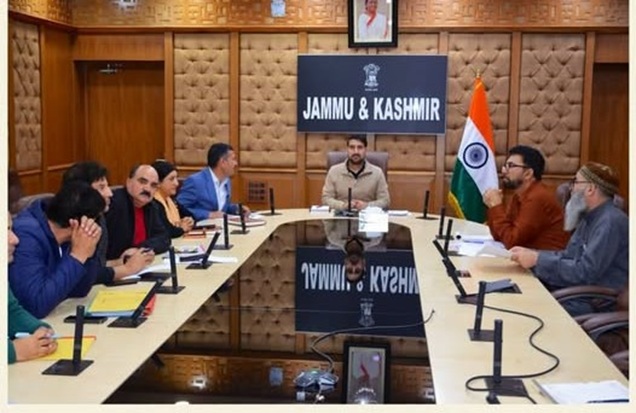
JAMMU, FEBRUARY 10: Secretary, Rural Development Department and Panchayati Raj, Mohammad Aijaz Asad, today chaired a high level review meeting to assess the implementation, progress and on-ground impact of Rashtriya Gram Swaraj Abhiyan (RGSA) and Swachh Bharat Mission–Grameen (SBM-G) across Jammu and Kashmir.
The meeting was attended by Director General Rural Sanitation Anoo Malhotra; Director RDD Kashmir Shabir Hussain Bhat; Director Panchayati Raj Sham Lal; Director RDD Jammu Shahnaz Akhter; Additional District Development Commissioners; Deputy Secretary RD&PR Tahir Ahmad Magray; Superintending Engineers REW; Assistant Commissioners Panchayat; Executive Engineers and other concerned officers.
The Secretary reviewed the component wise and district-wise status of tendering under SBM-G, including major sanitation infrastructure such as Faecal Sludge Treatment Plants (FSTPs), GOBARdhan plants, DEWATS, Community Sanitary Complexes, Plastic Waste Management Units, Segregation Sheds and other sanitation assets.
He directed the officers to expedite tendering process, remove procurement bottlenecks and ensure transparency, quality and adherence to timelines so that assets are made operational without delay.
Reviewing the progress of Individual Household Latrines (IHHLs), the Secretary assessed coverage, pendency and district-wise performance.
He stressed that no eligible household should be left out and directed the district authorities to fast-track verification and approval of pending applications alongside enhanced community mobilisation to achieve universal sanitation coverage.
The meeting also reviewed Operation and Maintenance (O&M) mechanisms and Faecal Sludge Management (FSM) policies.
Emphasising sustainability, the Secretary directed for early finalisation and operationalisation of O&M and FSM frameworks. He stressed that functionality and maintenance of sanitation assets must receive top priority.
The Secretary reviewed the Annual Implementation Plan (AIP) 2026-27 under SBM-G, stressing it be realistic, outcome-oriented and aligned with ground-level needs.
He emphasized quality infrastructure, behavioural change, sustainability, convergence and data-driven planning, directing for timely submission to ensure smooth implementation.
Asking the Additional District Development Commissioners to fast-track land identification for remaining Panchayats, the Secretary called for early resolution of bottlenecks and advised exploring relocation options where suitable land is unavailable. He also stressed according top administrative priority to completion of construction of Panchayat Ghars.
Reviewing the status of Gram Panchayat Development Plans (GPDPs), the Secretary underscored the need for participatory, need-based and outcome-oriented planning, with strong community participation and effective convergence with departmental schemes.
The meeting also reviewed the progress of co-location of Common Service Centres (CSCs) in Panchayat Ghars.
The Secretary directed for expediting the process to ensure CSCs are operational, thereby strengthening digital governance and citizen-centric service delivery.
Reviewing the functioning of Panchayat Learning Centres (PLCs), the Secretary directed all Assistant Commissioners Panchayat to make PLCs fully functional and asked both Directors RDD to operationalise 40 newly established PLCs.
Highlighting the Panchayat Advancement Index (PAI) 2.0 as a key tool for performance assessment, the Secretary directed the officers to create widespread awareness among Panchayats and stakeholders and ensure active participation for effective implementation of the index.
|